
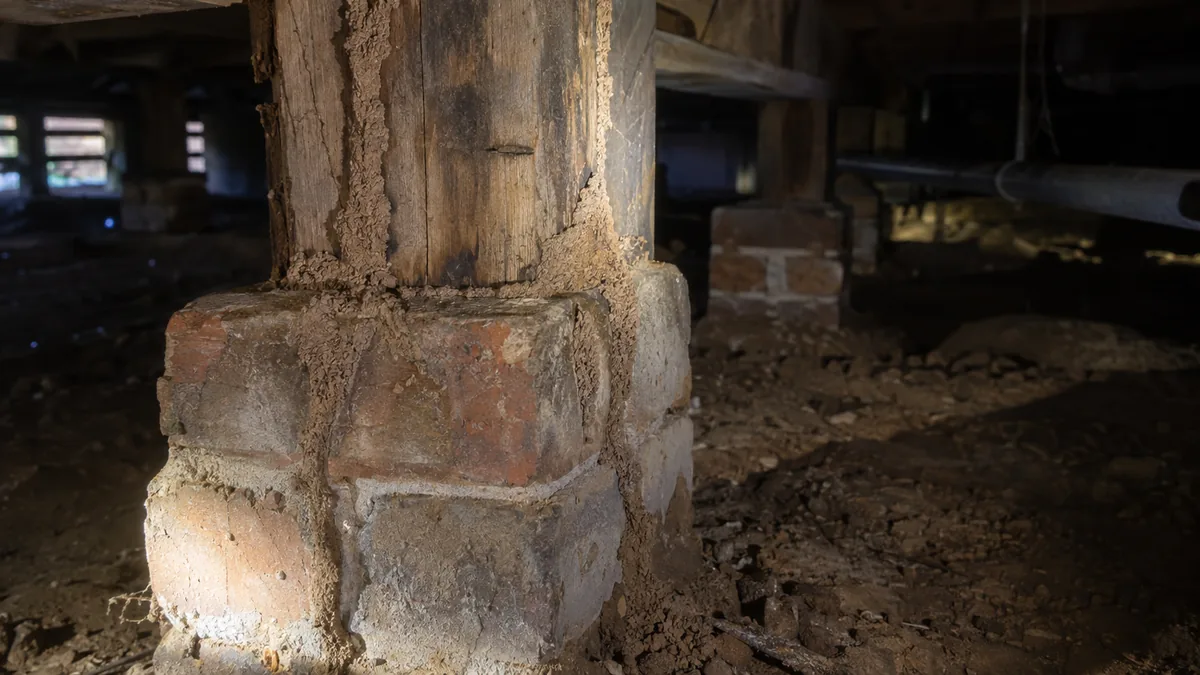
From mud tubes on stumps to discarded wings on window sills, here are the signs of termites Inner West homeowners should know, why local weatherboards are at risk, and what to do if you spot them.
Why Inner West homes are so exposed to termites
Subterranean termites need two things: moisture and a food source of cellulose. Melbourne’s Inner West offers both in abundance. Most of the housing stock in suburbs like Yarraville, Seddon, Kingsville and Footscray is Victorian or Edwardian weatherboard built on timber stumps, with a subfloor that is often damp and poorly ventilated. The clay soils across the area hold moisture, and the Maribyrnong River and Stony Creek corridors keep nearby ground wetter for longer.
Add mature eucalypts along streets and in parks, decades-old timber fences, garden sleepers and retaining walls, and you have a landscape that supports termite colonies and gives them a sheltered route to the house.
Species you are most likely to meet
The two subterranean species that matter most in this part of Melbourne are Coptotermes acinaciformis and Nasutitermes exitiosus. Coptotermes acinaciformis is the more destructive of the two, nesting in tree bases, stumps and sometimes within wall cavities, and capable of doing serious structural damage quickly. Nasutitermes exitiosus builds mound nests in the ground and is easier to spot in a garden, but still attacks fences, sleepers and house timber. Both travel through soil and mud tubes and avoid open air and light.
The signs of termites to look for
Termites are secretive by design. They eat timber from the inside, leaving a thin outer skin, and they seal themselves away from light and dry air. That means the signs are usually subtle until damage is well advanced. Here is what to check.
| Sign | What it usually means |
|---|---|
| Mud tubes on stumps, piers or brickwork | Termites are actively travelling between soil and timber. One of the clearest signs of subterranean termites. |
| Hollow-sounding skirtings or architraves | Timber has been eaten from the inside. Tap it with a screwdriver handle and listen. |
| Blistered, rippled or bubbling paint | Termites are working just beneath the surface, or moisture is present. Either way, get it checked. |
| Sagging or spongy floors | Bearers, joists or floorboards may have lost strength. |
| Doors and windows that stick | Frames may be distorted by termite tunnelling or the moisture termites bring in. |
| Mud packing in cracks and joints | Termites are sealing gaps to keep their workings humid. Often seen at brick joints, cornices and around pipes. |
| Flying termites (alates) | A mature colony is nearby and swarming to start new ones. |
| Discarded wings on sills | Alates have landed, shed their wings and are looking for somewhere to nest. |
| Faint clicking or rustling in walls | Soldier termites signalling, or workers feeding. Quiet house, ear to the wall. |
Mud tubes on stumps, piers and brick
Subterranean termites cannot survive long in the open, so they build covered mud tubes from soil, saliva and droppings to travel from the ground to your timber. Look at the stumps and piers in the subfloor, the base of brickwork, around downpipes, and on any timber that meets the ground. A tube can be as narrow as a pencil. If you break a small section and it is repaired within days, the colony is active.
Hollow timber and damaged skirtings
Termites eat along the grain and leave the painted or outer surface intact. A skirting board or architrave that sounds hollow, feels papery, or gives way under light pressure from a screwdriver has likely been eaten out. Check door frames, window frames and the bottom of built-in cupboards, especially in wet areas such as bathrooms and laundries.
Blistered paint, sagging floors and sticking doors
When termites work close behind paint or plaster, the surface can bubble, ripple or look water-stained. Floors that have started to dip, bounce or feel soft in one spot suggest damage to the bearers or joists beneath. Doors and windows that suddenly stick can be a sign of frames swelling with moisture that termites carry in, or of timber losing its shape as it is hollowed out.
None of these signs proves termites on its own. Damp and settlement can cause similar symptoms. But in a weatherboard on stumps in the Inner West, they are reason enough to book a termite inspection.
Mud packing in cracks
Termites plaster over gaps to keep their tunnels dark and humid. Look for small patches of dried mud in brick mortar joints, along cornices, at the junction of skirting and floor, around plumbing penetrations and in cracks in a concrete slab or path. Mud packing is easy to dismiss as dirt, but it is one of the more reliable signs of active workings.
Alates and discarded wings
On warm, humid evenings in spring and early summer, mature colonies release winged reproductives known as alates. If you see a cloud of flying termites around outdoor lights, or a scatter of translucent wings on a window sill or in a spider web the next morning, there is a colony close by. Alates are often mistaken for flying ants. Termites have straight antennae, a thick waist and two pairs of wings of equal length; ants have a pinched waist and unequal wings.
Clicking sounds
In a quiet house, especially at night, you may hear faint clicking or rustling inside walls or skirtings. Soldier termites bang their heads against the tunnel walls to signal danger, and large numbers of workers feeding can be audible. It is an unusual sign to catch, but if you hear it, do not dismiss it.
What is not a sign of subterranean termites
Piles of fine, sand-like pellets, known as frass, are often listed online as a termite sign. In Melbourne that is misleading. Frass is typical of drywood termites, which are rare in Victoria, and of timber borers. Subterranean termites keep their droppings inside their workings and use them to build mud. If you see frass, you may have a borer problem, which a timber pest inspection to AS 4349.3 will identify, but it is not the usual calling card of the species that attack Inner West homes.
What to do if you find signs of termites
The most important rule is simple: do not disturb them.
- Do not break open mud tubes, pull off skirtings or dig into damaged timber to have a look.
- Do not spray the area with fly spray or hardware-store insecticide.
- Do not knock on the wall repeatedly or shine bright lights into the workings.
- Do photograph what you have found, from a distance, with something for scale.
- Do note where and when you saw it, and whether any moisture is nearby.
- Do book a professional inspection as soon as you can.
The reason is that termites react to disturbance by abandoning that spot and moving elsewhere in the house. Spraying kills a few hundred workers and sends the rest of the colony, which can number in the hundreds of thousands, into the wall next door. A licensed inspector needs to see the active workings intact to identify the species, trace the entry point and choose the right termite treatment. Treatment of existing buildings is carried out with reference to AS 3660.2.
How often should you look?
Annual inspections are recommended for most homes, and older weatherboards in high-risk pockets near the river, the creek or established parkland may warrant more frequent checks. If you are buying, a pre-purchase termite inspection before you commit is the only way to know what is under the floor. Between professional visits, a quick look at stumps, skirtings and window sills every few months costs nothing and can catch a problem early.
Next steps
If any of the signs above look familiar, leave the area alone, take a few photos and get in touch. Read our FAQs for what an inspection involves, or contact us with your suburb and a description of what you have seen. We will tell you honestly whether it needs an urgent visit or can wait for a routine inspection.
- signs of termites
- mud tubes
- flying termites
- weatherboard homes
- Inner West Melbourne
Last updated 22 September 2026. Published by Termite Inspection Melbourne.